Read Journal
Example text
Your cart is empty.
Happy shopping!
In creating his design for the Coffee Table, Isamu Noguchi translated the biomorphic aesthetic of his sculptural works into a piece of furniture with distinctive organic forms. Presumably for this reason, Noguchi regarded the table as his best furniture design. Two wooden leg elements are positioned at a right angle to provide a stable support for the heavy, sturdy glass top.
***This item is ex-display***
Dimensions: 128cm L x 92cm W x 40cm H
Materials: Table top: Heavy glass, 19 mm, ground rounded edges.
Solid wood base: Walnut with oiled finish, rounded edges.
Downloads: Product Fact Sheet
This item is currently unavailable as an online purchase - please contact us to order

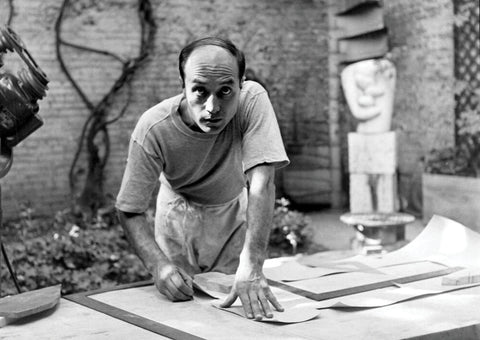
Isamu Noguchi (1904-1988) is considered one of the most important artists of the 20th century, expanding the traditional notion of sculpture to include the creation of dance sets, gardens, playgrounds, fountains and furniture.
Isamu Noguchi was the son of an American mother and a Japanese father. Born in Los Angeles, Noguchi spent his childhood in Japan before returning to the US for his education. As a young man he travelled to Paris to work with sculptor Constantin Brancusi, and he went on to develop his own career as an artist in New York.
After visiting Japan in 1931, Noguchi began to integrate elements of Japanese art with Western modernism. Throughout the 1950s Noguchi spent a great deal of time in Japan, embracing Japanese forms for the design of gardens and sculpture.
Shop Designer >